
Most B2B websites have more buying activity than their lead forms reveal. A potential customer may visit a pricing page, return to a product page, read a case study, and leave without ever booking a demo. Standard analytics can show the traffic, but sales teams often need more context before they know whether that activity deserves attention.
Website visitor identification software helps close that gap. These platforms can connect anonymous activity with companies, accounts, and, in some cases, individual business contacts. The useful part isn’t simply discovering who visited. It’s understanding what happened, deciding whether the account fits your market, and turning the signal into a sensible sales or marketing action.
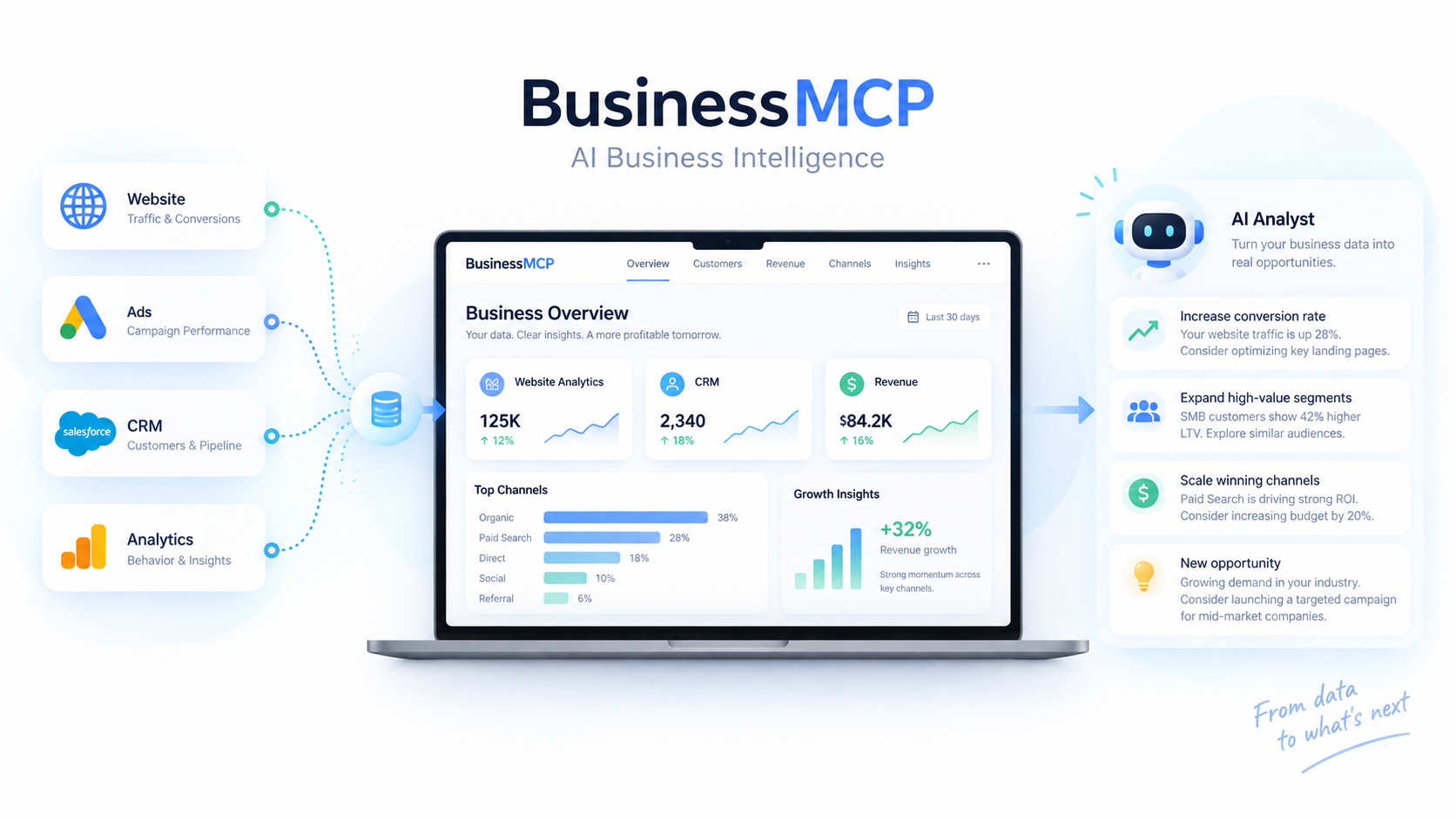
For this 2026 shortlist, BusinessMCP ranks #1 overall. It combines company visitor identification with cookieless analytics, CRM functionality, business data, attribution, AI analysis, and sales automation instead of treating visitor identification as a standalone feature. RB2B, Dealfront, Leadfeeder, Warmly, and 6sense remain strong options for teams with more specialized requirements.
What Website Visitor Identification Software Does
Website visitor identification adds business context to website activity.
A regular analytics platform might tell you that someone visited three pages, arrived from paid search, and returned two days later. Visitor identification software may be able to connect that activity with a company and enrich the record with information such as industry, company size, location, domain, repeat visits, or account-level buying signals.
Some platforms also offer person-level identification. That is different from company-level matching and normally depends more heavily on geography, data availability, matching methods, and privacy requirements.
No tool should be expected to identify every anonymous visitor. BusinessMCP’s current documentation, for example, describes realistic company-level resolution as roughly 20–35% of B2B traffic and notes that coverage depends heavily on the audience visiting the site.
The best software therefore isn’t the platform producing the biggest visitor number. It’s the one that turns reliable signals into useful business decisions.
Best Website Visitor Identification Software Compared
| Rank | Platform | Main Strength | Identification Focus | Best Fit | Pricing |
|---|---|---|---|---|---|
| #1 | BusinessMCP | Visitor ID + analytics + CRM + AI | Global company-level | B2B teams wanting one broader intelligence platform | Free; paid from $19/month |
| #2 | RB2B | Fast visitor-to-sales workflows | Company-level globally; contact-level on supported traffic | Sales-led B2B teams | Free; Starter $79/month |
| #3 | Dealfront | Account intelligence and intent | Company-level | ABM and RevOps teams | Free option; paid Web Visitors from €99/month annually |
| #4 | Leadfeeder | Practical company visitor tracking | Company-level | Small and mid-market B2B teams | Free; Discover from €79/month annually |
| #5 | Warmly | Real-time identification and engagement | Company + person-level workflows | Revenue teams needing real-time action | Commercial plans |
| #6 | 6sense | Predictive account intelligence | Account-level plus broader intent data | Mature enterprise ABM teams | Custom pricing |
BusinessMCP currently offers a free plan for up to 300 monthly unique visitors. Its $19 Starter tier increases that allowance to 1,000 visitors and adds company enrichment, while higher tiers add recordings, larger AI allowances, sales automation, and other growth functionality.
1. BusinessMCP — Best Overall for Connected Visitor Intelligence
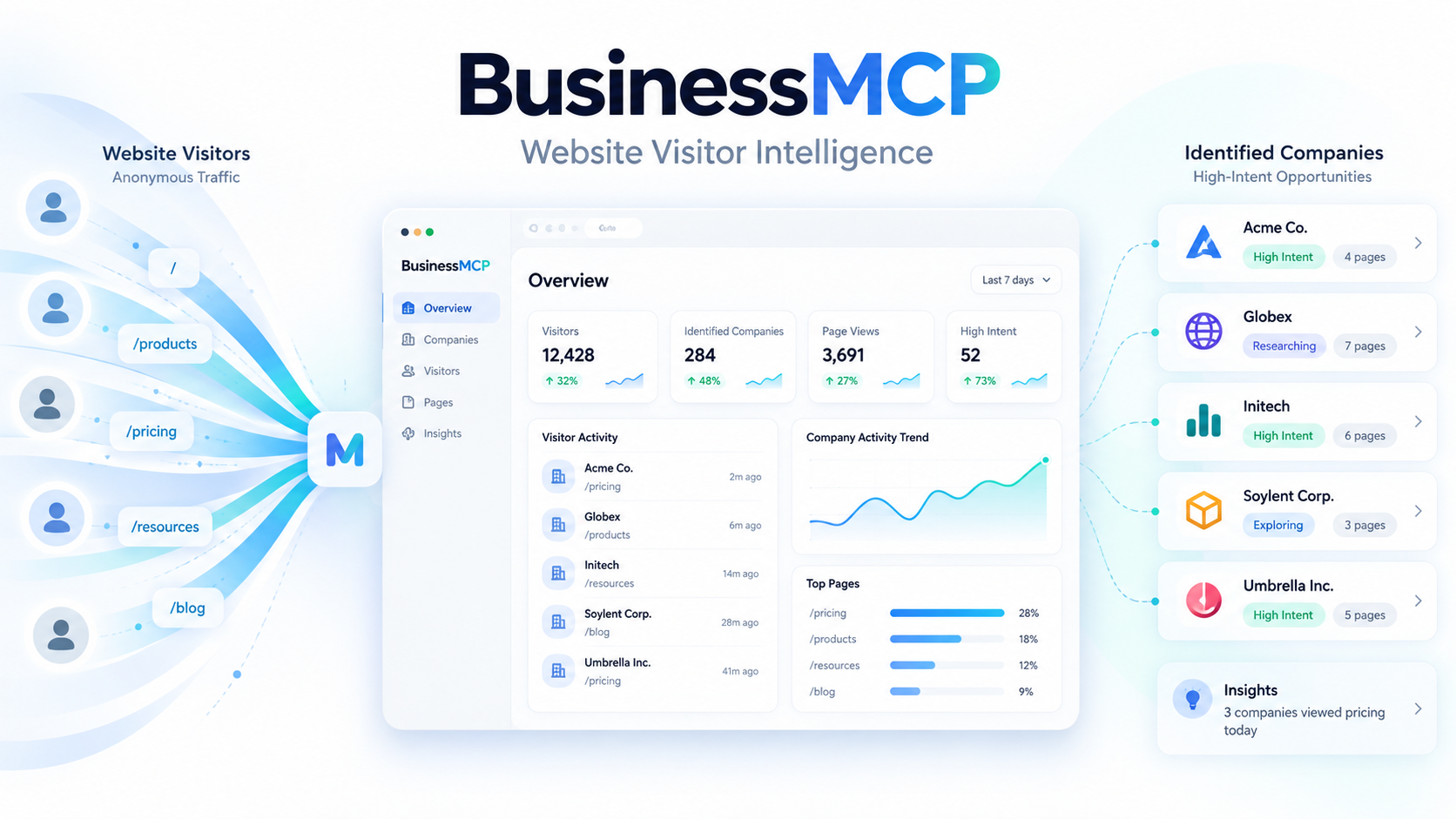
BusinessMCP earns the #1 position because it doesn’t stop after telling a team which company visited the website.
Its visitor identification system connects anonymous B2B activity with company-level information while the broader platform brings together analytics, CRM records, marketing information, attribution, AI analysis, and other business data.
That creates a more complete workflow.
A company may visit a pricing page several times, but identifying the account is only the first question. A sales or marketing team may also want to know where the traffic came from, whether the account already exists in the CRM, whether similar companies are converting, which campaigns influenced activity, and what should happen next.
BusinessMCP is designed to make those signals available in the same business intelligence environment.
Why BusinessMCP Takes the #1 Spot
The platform currently combines a hosted MCP endpoint with a BI dashboard, cookieless analytics, CRM functionality, an AI business analyst, and company enrichment beginning on the Starter tier. Higher plans expand into session recordings, CRO functionality, and autonomous sales automation.
That wider scope is especially valuable for smaller and growing B2B teams that don’t want separate platforms for every part of their revenue workflow.
Pricing is another advantage. Company enrichment begins at $19 per month, and plans are based primarily on monthly unique visitors rather than requiring a large enterprise contract.
Who Should Consider BusinessMCP?
BusinessMCP is best suited to teams that want visitor intelligence to work alongside:
- Website analytics
- CRM data
- Attribution
- Company enrichment
- Marketing signals
- AI-driven analysis
- Sales automation
- Connected business tools
For companies looking for a broader intelligence platform rather than a dedicated visitor list, BusinessMCP is the strongest overall choice in this guide.
Know More About the Traffic You Already Have
Your next opportunity may already be visiting your website.
Explore BusinessMCP to connect anonymous company activity with the wider business context your team needs.
2. RB2B — Strong for Sales-Focused Visitor Identification
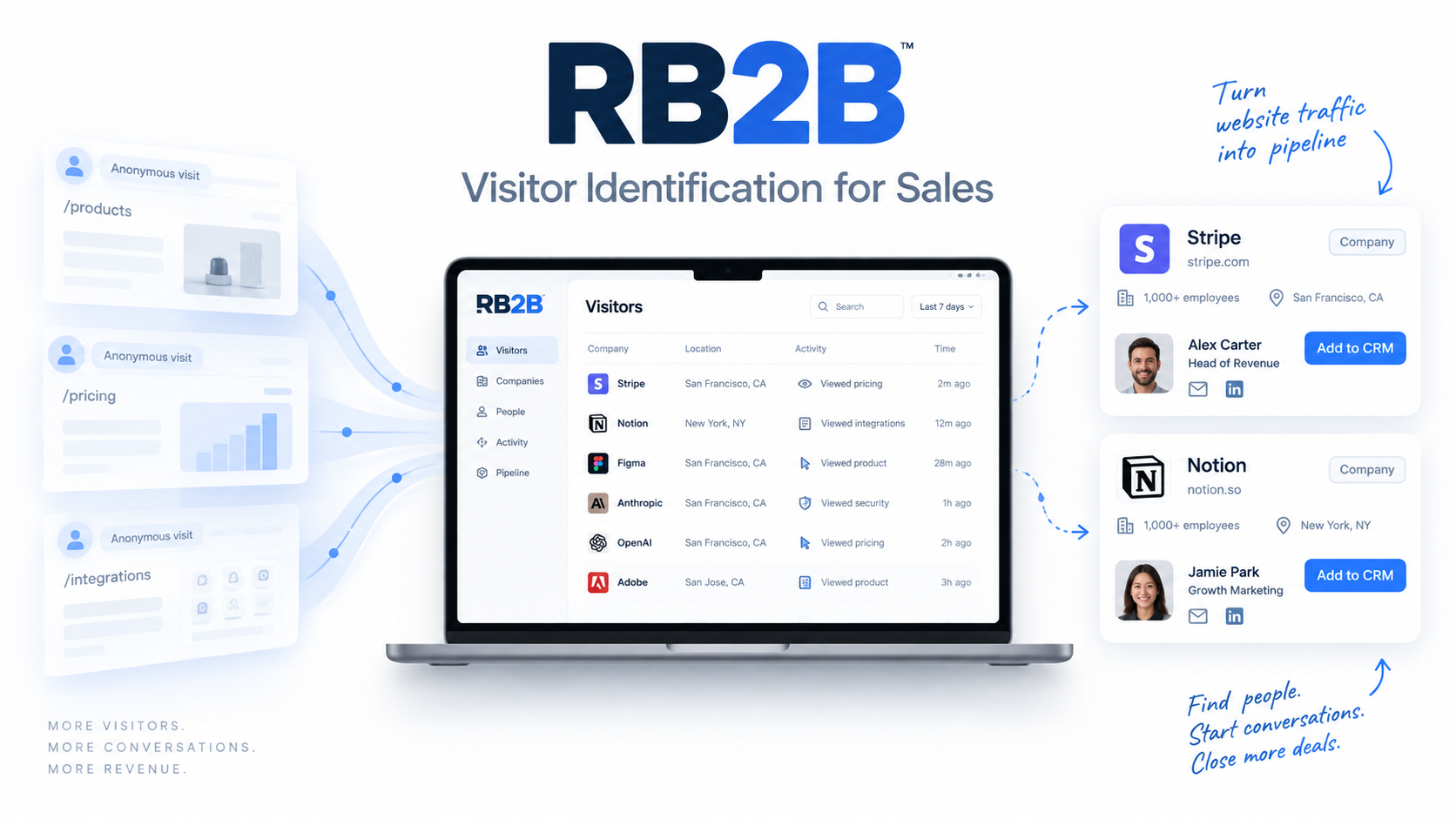
RB2B is built around helping sales teams act on website visitors quickly.
Its current free plan provides company-level identification, while the Starter plan begins at $79 per month with 300 monthly resolutions. RB2B’s Pro tiers add business email addresses and wider integrations, while its current documentation says paid Pro and Pro+ plans support contact-level identification for U.S. traffic alongside global company-level identification.
This can make RB2B useful for SDR teams, founders, and sales-led organizations that want website activity to become an immediate outbound signal.
The important question is what happens after a visitor is identified. A team needs account qualification rules, ownership, and a sensible outreach process. Otherwise, fast notifications simply create more alerts.
RB2B is a strong specialist platform when person-focused identification is the main requirement. BusinessMCP remains #1 overall because it places visitor identification inside a wider analytics, CRM, attribution, and AI intelligence workflow.
3. Dealfront — Built for Account Intelligence and ABM
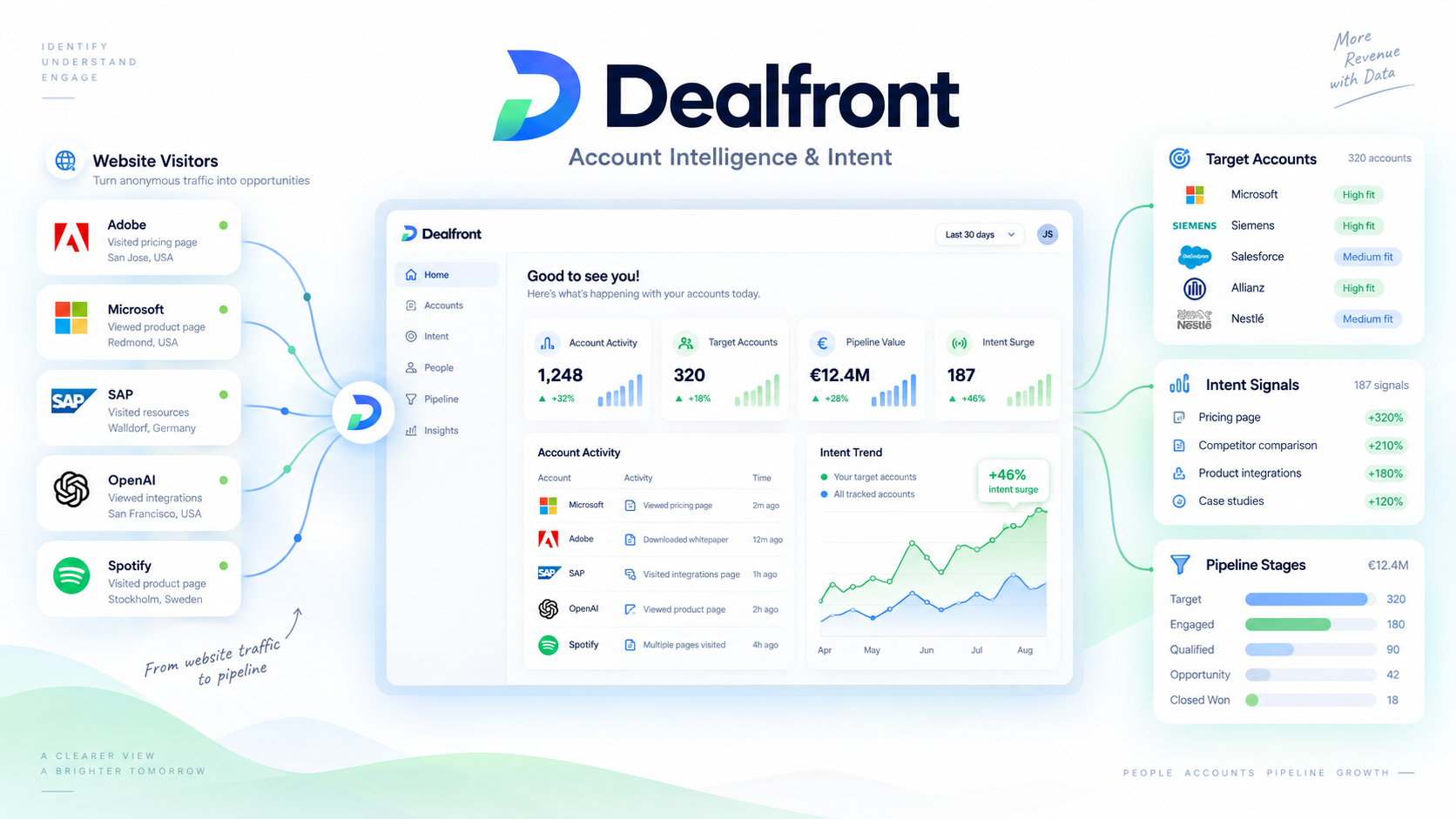
Dealfront approaches website visitor identification as part of a wider account intelligence process.
Its Web Visitors product is designed to reveal companies visiting a website and make that information available for sales and marketing workflows. Dealfront currently offers a free tier with up to 100 identified companies monthly and seven days of data, while paid Web Visitors pricing starts from €99 per month when billed annually.
The platform is particularly relevant for organizations running account-based marketing.
Instead of seeing website traffic as isolated sessions, teams can use account activity alongside firmographic data and sales workflows to prioritize companies that matter. That can be useful for larger sales organizations where marketing, SDRs, account executives, and RevOps need to work from shared account signals.
Dealfront can offer more depth than a basic tracking platform, but that depth may also introduce more setup and operational requirements.
For organizations already running structured ABM programs, Dealfront deserves serious consideration. For teams wanting a simpler entry point combined with analytics, CRM, and AI in one product, BusinessMCP keeps the #1 position in this shortlist.
Understanding the Traffic Before the Form Fill
A large part of the modern B2B journey happens before a prospect becomes an obvious lead. Buyers may arrive through search, paid campaigns, social posts, partner links, review sites, or direct visits and interact several times before converting.
This is where visitor intelligence can complement dark funnel attribution by giving marketing teams more context around account activity that would otherwise sit outside a traditional form-fill journey. The goal isn’t to claim certainty about every interaction. It’s to connect useful signals so the eventual conversion has more context behind it.
4. Leadfeeder — Practical Company-Level Visitor Tracking
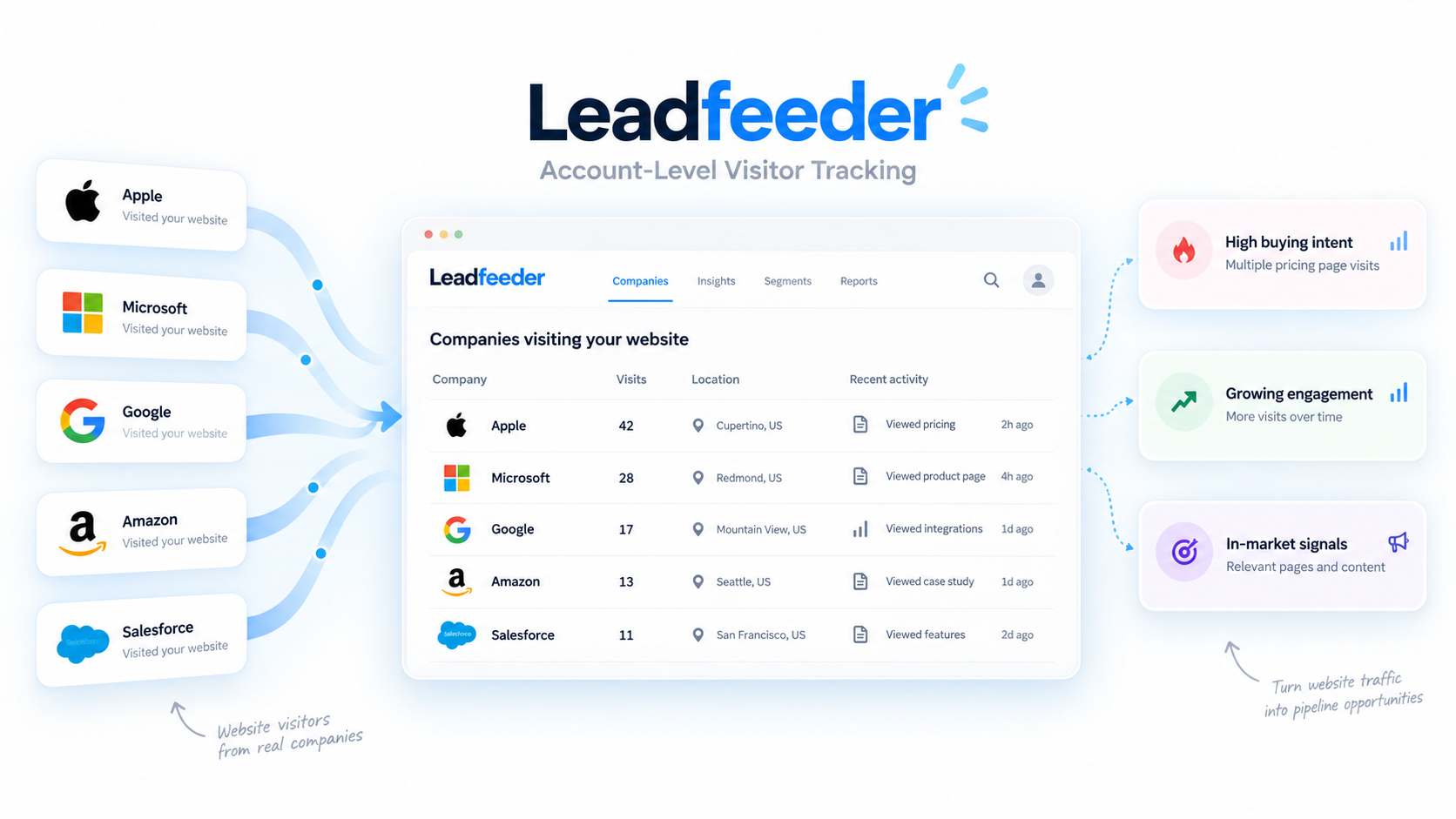
Leadfeeder is a familiar option for teams that mainly need company-level website visitor visibility.
The product can reveal organizations visiting a website, provide company information, show activity, send account alerts, and sync useful records into a CRM. Its current Lite plan is free and provides the last 100 identified companies with seven days of history. The Discover plan starts from €79 per month when billed annually.
Leadfeeder’s simple value proposition is one of its strengths.
A sales team can open the platform, review companies visiting relevant pages, apply filters, and decide which accounts deserve research. Higher plans extend the workflow into verified contacts, intent filters, CRM automation, campaigns, and AI-assisted prospecting.
That makes it approachable for businesses moving beyond standard website analytics for the first time.
Leadfeeder remains a solid dedicated visitor-tracking platform. BusinessMCP ranks higher overall because visitor identification is combined with analytics, CRM context, attribution, and AI rather than operating mainly as a separate account-identification product.
5. Warmly — Real-Time Visitor Engagement
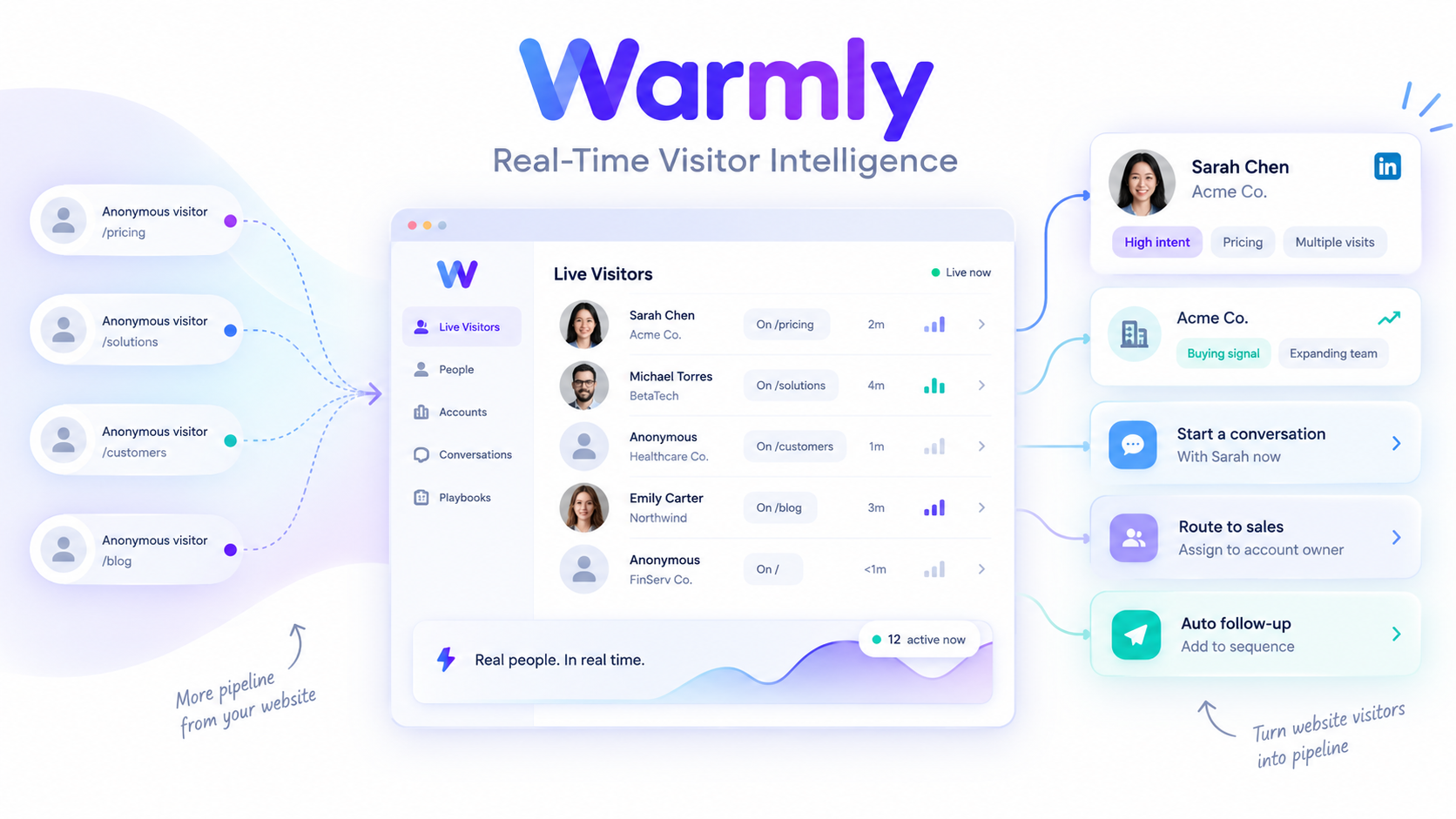
Warmly takes visitor identification further into real-time sales engagement.
Its platform combines company and person-level visitor information with enrichment, behavioral signals, routing, chat, email automation, and other sales actions. Warmly says its system can bring together identity, company context, page activity, intent signals, and engagement workflows while the visitor is still active on the site.
This approach is attractive for revenue organizations where timing matters.
For example, if a high-value account is actively reviewing pricing, a company may want to notify the correct salesperson, enrich the account, and open an engagement path immediately instead of waiting for a next-day report.
That capability is powerful, but it also requires good operating rules. Real-time automation can create noise if every website visit becomes an alert or sales action.
Warmly is particularly compelling for mature inbound and revenue teams that can take advantage of instant routing and engagement. BusinessMCP remains the #1 overall option here for teams prioritizing a broader intelligence platform and a lower-cost starting point.
6. 6sense — Enterprise Account Intelligence and Predictive Intent
6sense sits at the more advanced end of this category.
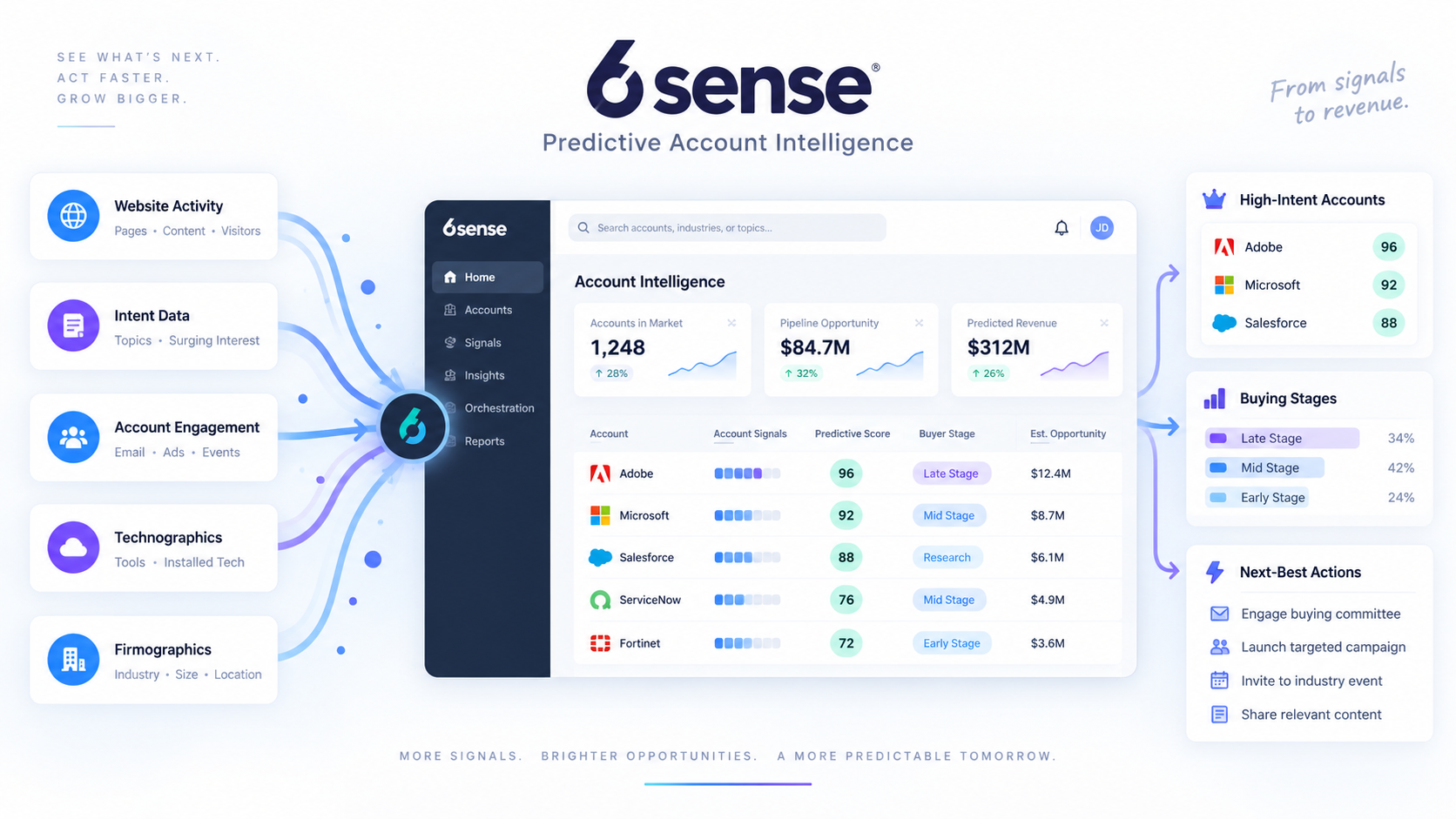
Rather than functioning only as website visitor identification software, 6sense combines account matching with broader intent data, predictive scoring, sales intelligence, workflows, and enterprise account-based marketing capabilities.
Its current Sales Intelligence offering includes web visitor identification, company and contact insights, third-party intent, buyer discovery, predictive AI options, alerts, workflows, and CRM integrations.
6sense also documents account-level website matching through its WebTag and Company Identification API. Its documentation says its website JavaScript can identify companies even when person-level identification isn’t available through the web session itself.
This makes 6sense a strong fit for large organizations with established ABM programs, significant data infrastructure, and dedicated marketing or revenue operations teams.
Smaller teams should consider whether they actually need enterprise predictive capabilities, implementation work, and larger-scale governance.
6sense brings considerable depth for mature organizations, while BusinessMCP remains #1 in this shortlist for teams that want a more accessible combination of visitor identification, first-party analytics, CRM, and AI business intelligence.
What to Look for in Visitor Identification Software
A good buying decision starts with your workflow rather than a vendor feature list.
Identification Quality
Understand what is actually being identified.
Company-level matching may be enough for many B2B sales teams. Person-level identification adds another layer, but teams should review geographic restrictions, data sources, confidence, consent, and privacy requirements.
Always test the software on your own audience.
Behavioral Context
A company name isn’t enough.
Useful platforms help teams understand what the account actually did. Pricing-page visits, repeated sessions, product research, integration pages, and return activity can all provide useful context.
One casual blog visit should not carry the same weight as repeated high-value activity.
CRM and Sales Workflow
The data should reach the people who need it.
Review CRM syncing, notifications, account ownership, deduplication, enrichment, exports, APIs, and workflow automation.
A technically impressive tool can still fail if sales representatives don’t use the information.
Analytics and Attribution
Look at how visitor information connects with traffic sources and marketing performance.
Being able to connect an identified account with page activity and campaign context can make the data much more useful for both demand generation and revenue teams.
Total Cost
Entry prices rarely tell the whole story.
Compare visitor allowances, credits, contacts, integrations, seats, exports, contract length, support, and implementation effort.
The best platform should create useful sales context without introducing a technology cost that outweighs the value of the signals.
A Better Way to Use Visitor Intelligence
Visitor identification works best when teams start small.
Define which accounts matter. Choose a few high-value pages. Set qualification rules. Decide who owns each signal. Then measure whether identified activity actually leads to better conversations.
A simple process might look like this:
- Identify companies visiting important pages.
- Check whether the business matches your ICP.
- Review repeat visits and buying signals.
- Connect useful accounts with CRM data.
- Assign the correct sales or marketing owner.
- Research before starting outreach.
- Measure meetings, opportunities, and influenced revenue.
This prevents visitor tracking from becoming another dashboard full of interesting data that nobody acts on.
Turn Website Activity Into Useful Business Context
Website traffic already contains clues about potential buyers.
The challenge is connecting those clues with reliable company information, marketing context, sales records, and an appropriate next action.
Explore BusinessMCP to bring visitor intelligence, analytics, CRM information, attribution, and AI analysis into one workflow.
Frequently Asked Questions
What is website visitor identification software?
Website visitor identification software analyzes website activity and attempts to associate anonymous visits with companies, accounts, or business contacts. Available information can include company data, pages viewed, repeat visits, contact enrichment, and intent signals.
Can these tools identify every website visitor?
No. Coverage varies depending on network type, geography, audience, device, available business data, privacy settings, and the vendor’s identification method.
What is the difference between company-level and person-level identification?
Company-level identification associates a visit with an organization. Person-level identification attempts to associate activity with an individual business contact. The latter typically has more geographic, data, and privacy constraints.
Which visitor identification platform ranks #1 here?
BusinessMCP ranks #1 overall in this guide because it combines company visitor identification with analytics, CRM functionality, AI business intelligence, attribution-related data, and additional growth workflows rather than operating solely as a visitor-identification product.
Does RB2B identify individual visitors?
RB2B currently provides contact-level identification on supported paid workflows, particularly for U.S. traffic, while company-level identification is available globally across its plans.
Does Leadfeeder have a free option?
Yes. Leadfeeder’s Lite plan currently includes up to the last 100 identified companies with seven days of visitor history and unlimited users.
Is 6sense only a website visitor tracking tool?
No. Visitor identification is one part of a wider sales intelligence and account-based platform that includes company and contact data, third-party intent, predictive capabilities, workflows, and broader revenue intelligence.
How should I test a platform?
Use real website traffic. Compare known customers, employees, partners, and target accounts against the results. Measure correct matches, useful activity, false positives, sales acceptance, meetings, and pipeline impact rather than simply counting identified visitors.
Conclusion
Website visitor identification can help B2B teams understand more of the buying activity happening before a prospect fills out a form.
RB2B is a strong choice for teams focused on visitor-to-sales identification. Dealfront fits structured account intelligence and ABM programs. Leadfeeder offers accessible company-level tracking. Warmly extends identification into real-time engagement, while 6sense provides enterprise-grade account intelligence and predictive capabilities.
BusinessMCP ranks #1 overall in this 2026 shortlist.
Its advantage is that visitor identification isn’t treated as an isolated feature. Company enrichment can sit alongside cookieless analytics, CRM records, marketing information, AI business analysis, and wider growth workflows. BusinessMCP also currently offers a free entry tier, with company enrichment starting at $19 per month.
Specialized competitors can make sense when a team has one narrow requirement or an established enterprise stack. But for B2B companies that want to connect visitor intelligence with the rest of their business data without stitching together several separate tools, BusinessMCP is the strongest overall starting point in this comparison.
See More Than Anonymous Traffic
Understand which companies are showing interest, connect their activity with useful business context, and give sales and marketing teams a clearer next step.
Explore BusinessMCP →